
The Energy Bill Is Coming for Everything: What Rising Oil, Gas, and Power Prices Mean for You
 ensembleadvisor
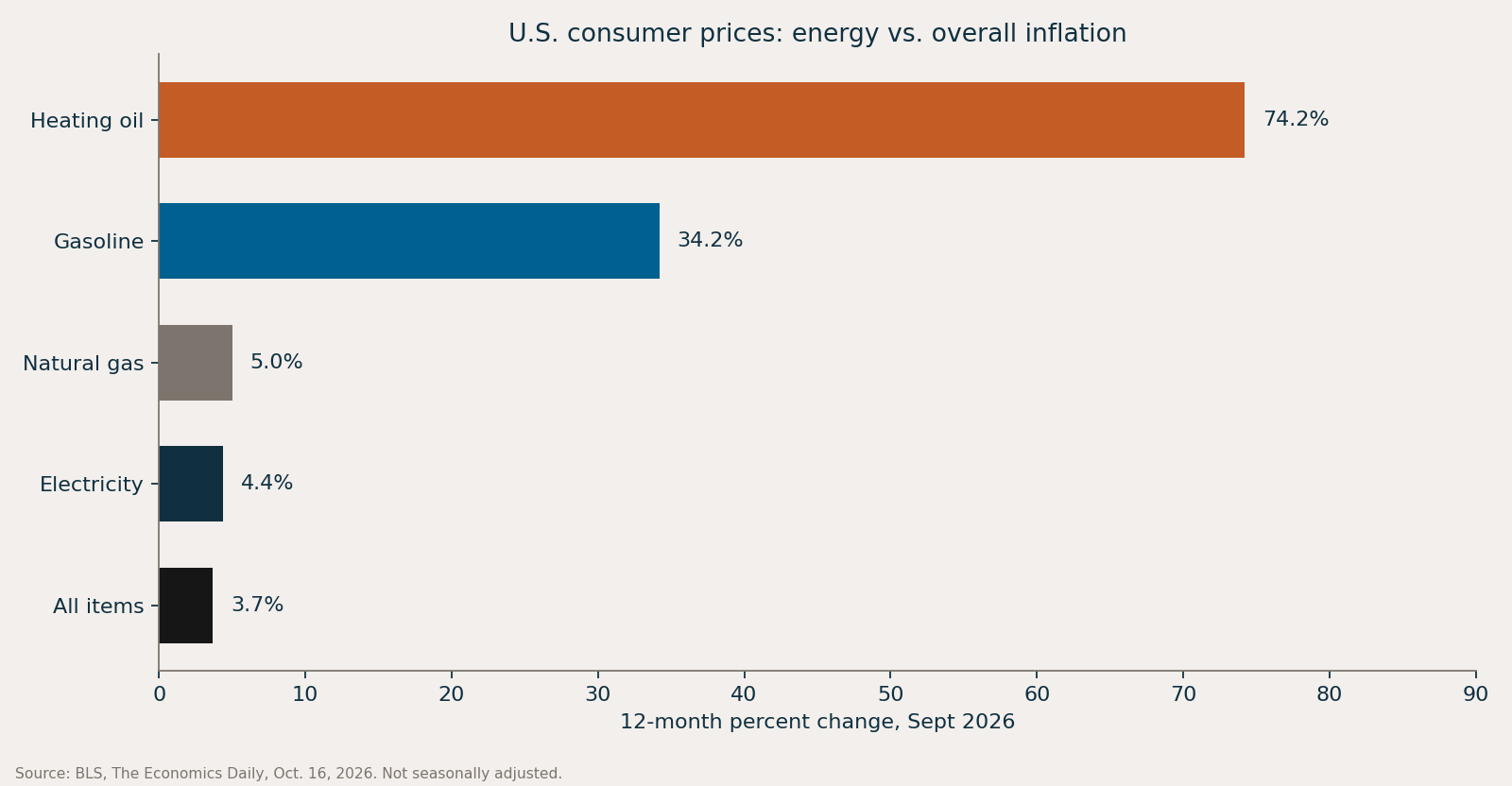
Filling your tank cost about a third more this September than it did a year earlier. Gasoline prices rose 34.2% in the 12 months through September 2026, and heating oil jumped 74.2%. Overall inflation rose just 3.7%.1
Those headline numbers are only the first round. Energy goes into almost everything you buy, so a spike at the pump and on the power bill eventually shows up in groceries, airfare, and rent. Here's what's driving it, which cities are getting hit hardest, where things could go by 2031, and what you can actually do about it.
Why energy costs are climbing on three fronts
Oil. The U.S. war with Iran and attacks on Gulf energy infrastructure have choked off supply. Brent crude, the global benchmark, averaged $114 a barrel in September, and U.S. diesel averaged $6.29 a gallon.2 The International Energy Agency says diesel is trading at nearly double the price of crude, which is “raising the cost of goods” across the economy.3
Electricity. This one is a slower climb, and it started before the war. U.S. electricity prices rose 42% between 2019 and early 2026, while overall prices rose 29%, according to Brookings.4 Power-hungry AI data centers are part of the reason: they require new power plants, transmission lines, and substations, and those costs often get spread across household bills.4 The Energy Information Administration (EIA), the government’s energy statistics agency, expects the average home electricity rate to rise from 17.3¢ per kilowatt-hour in 2025 to 18.2¢ in 2026 and 18.7¢ in 2027.5
Natural gas. For now, gas is the calm one. Inventories are healthy, and EIA expects households that heat with gas or propane to spend less this winter than last. Homes that heat with heating oil should brace for about 21% higher bills.2
Which cities are feeling it most
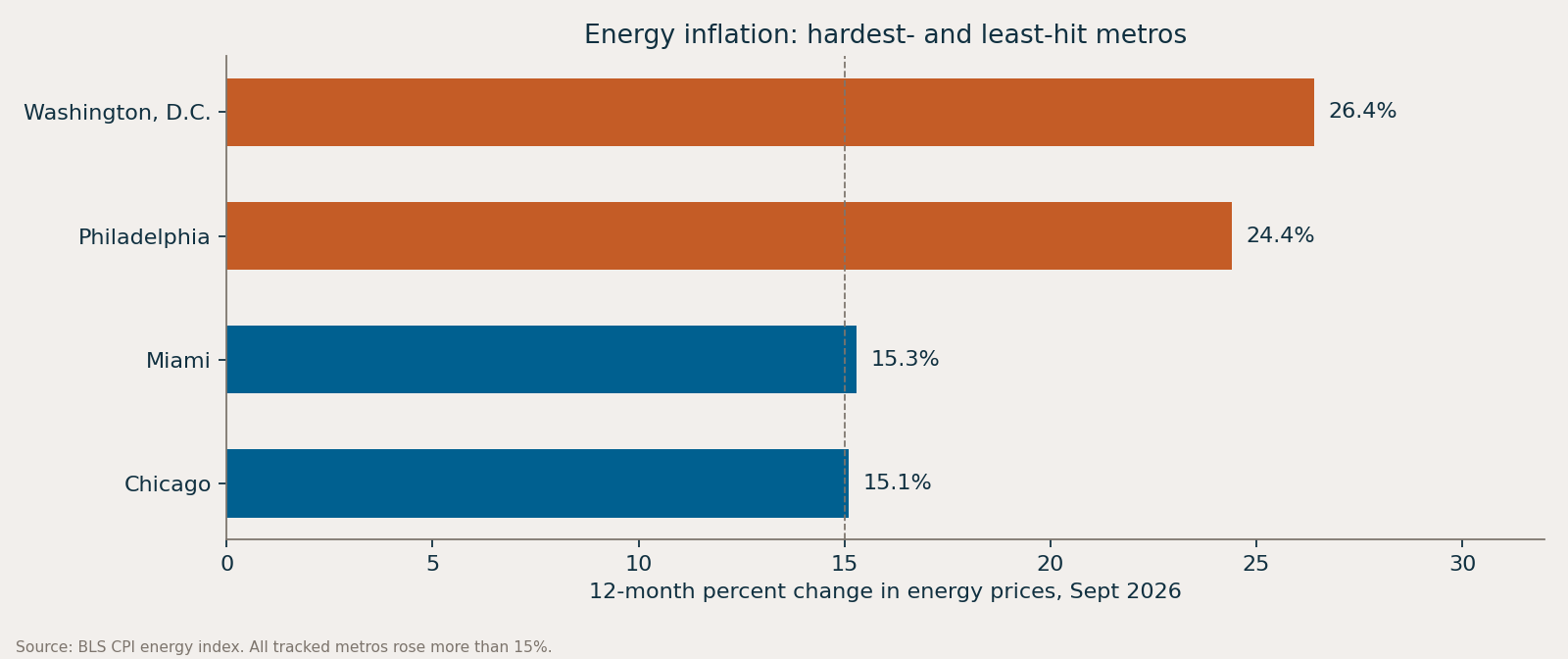
Every major metro tracked by the Bureau of Labor Statistics (BLS) saw energy prices jump more than 15% over the past year. Washington, D.C. (+26.4%) and Philadelphia (+24.4%) led, while Chicago (+15.1%) and Miami (+15.3%) had the smallest increases.6
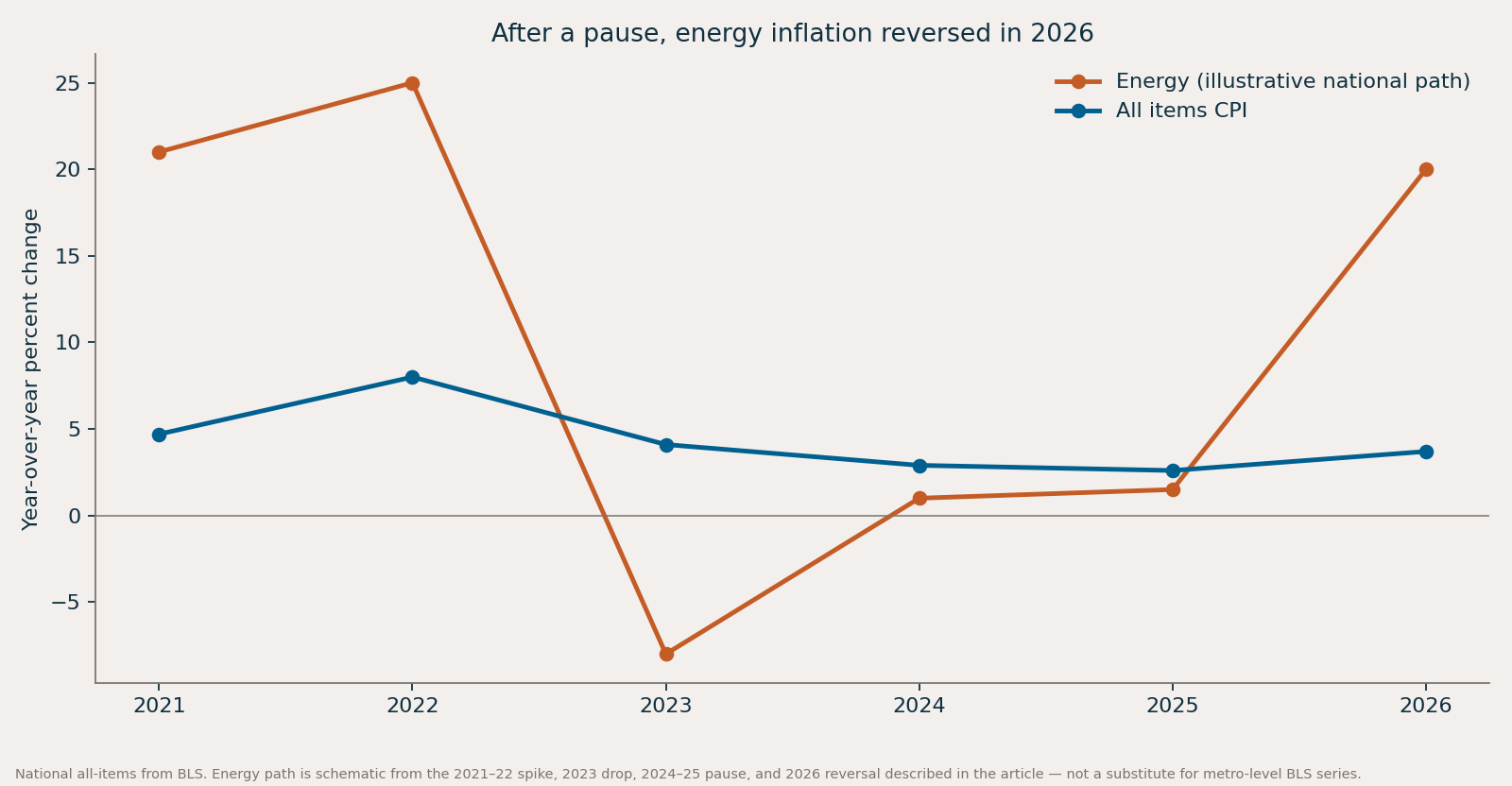
The year-by-year view shows how quickly things changed. After the 2021–2022 spike, energy prices fell in 2023 and stayed roughly flat through 2025 in most cities. Then 2026 reversed course everywhere.6
Where prices could be by 2031
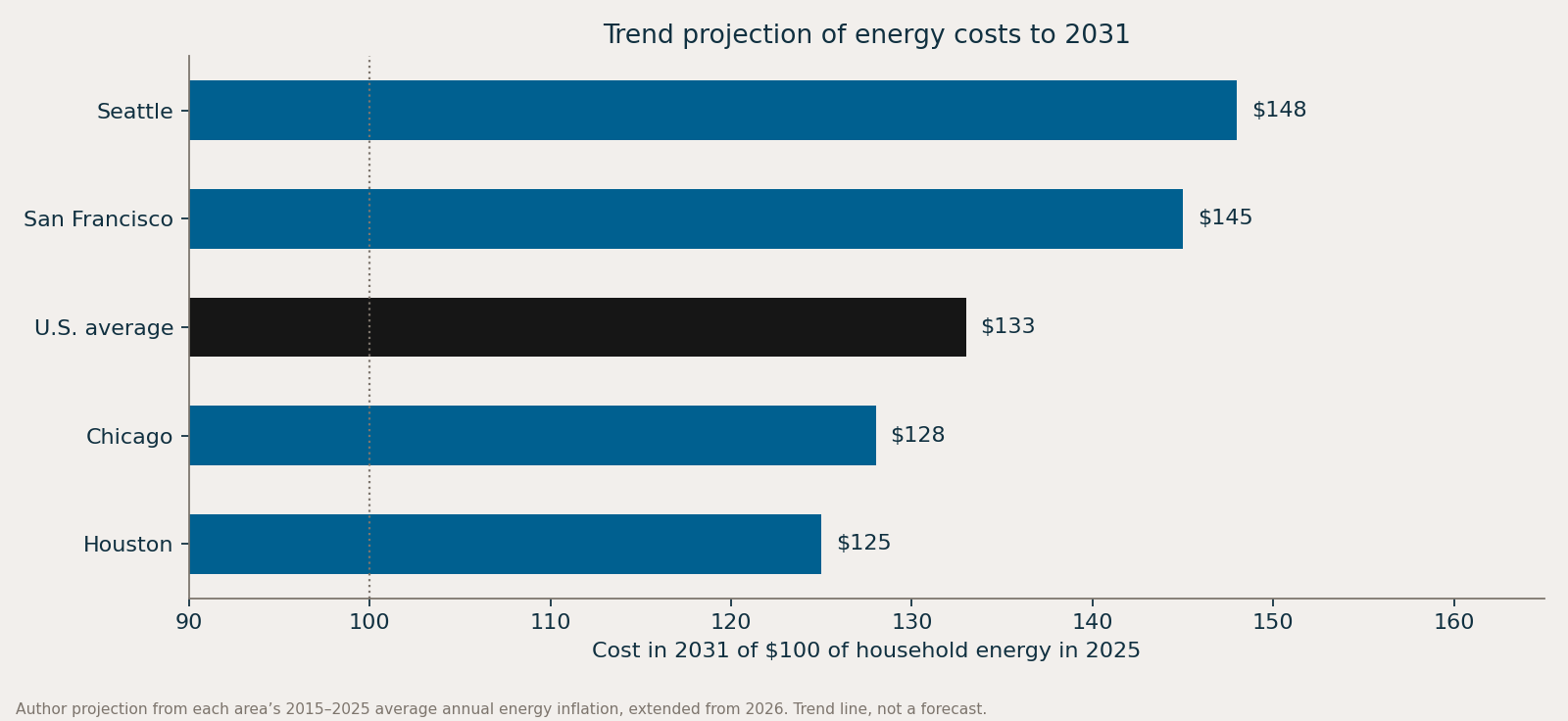
No one can forecast energy prices five years out with confidence, so treat the next chart as a trend line, not a prediction. I took each metro’s average annual energy inflation from 2015 to 2025 and extended it forward from 2026 levels.6
On that path, $100 worth of household energy in 2025 would cost about $133 nationally by 2031. In Seattle it would cost $148 and in San Francisco $145. Houston ($125) and Chicago ($128) fare best.
There’s an important caveat. EIA expects some relief in the short term: Brent falling to $84 in 2027 and gasoline dropping from an average of $3.91 this year to $3.56.2 Oil prices could ease. Electricity is the cost most likely to keep climbing, because grid upgrades get paid off over decades.
3 ways to cut your energy use starting this month
1. Program your thermostat. Turning your thermostat back 7–10°F for eight hours a day, such as while you sleep or work, can save as much as 10% a year on heating and cooling, according to the Department of Energy.7 A $100 programmable thermostat does it automatically. (If you have a heat pump, use a thermostat designed for heat pumps.)
2. Replace your biggest energy hog. If you have an old electric water heater, an ENERGY STAR heat pump model can save a family of four about $550 a year and pay back its extra cost in about three years.8 Those estimates assume 14.6¢ per kWh, so at today’s higher rates you’d save more. Many states also offer rebates on efficient appliances.9
3. Drive like you’re paying $4 a gallon (because you are). Speeding and hard braking can cut your fuel economy by 15–30% on the highway. Every 5 mph above 50 is roughly like paying an extra $0.30 per gallon.10 Easing off is the cheapest efficiency upgrade there is.
How investors are positioning for higher energy costs
This is general information, not personal financial advice. Talk to a licensed advisor before investing.
Energy producers have already surged. The S&P 500 Energy Index returned 55.9% this year through October 16, compared with 12.9% for the S&P 500.11 Diversified energy funds and pipeline companies give you exposure, but buying after a 56% run is risky if EIA’s forecast of cheaper oil in 2027 turns out right.
Utilities and the grid are a slower, longer-term bet. Power demand hit a record 541 gigawatts in September,11 yet the Morningstar US Utilities Index has fallen 16% from its February peak because of rising interest rates and regulatory delays for data centers. Morningstar now calls the sector 9% undervalued.12 Regulated utilities earn returns on what they build, so the grid buildout drives their profits.
Electrification and solar benefit from both trends. EIA projects U.S. solar capacity growing from 182 gigawatts in 2026 to 223 in 2027.5 Companies selling solar panels, heat pumps, batteries, and grid equipment benefit from higher bills because higher bills push more people to buy those products.
The smartest move is usually a diversified mix rather than a big bet on one fuel. Energy prices swing hard in both directions.
The bottom line
Oil prices could fall. The rising cost of power probably won’t. The gap between your income and your energy bill is the part you control: a few thermostat settings, one appliance swap, and a lighter foot on the gas pedal can win back a good share of what this year’s prices took. For investors, the long-term opportunity is in the grid and the technology that cuts energy use.
Sources
- “Prices for gasoline increased 34.2 percent over the year ended September 2026,” U.S. Bureau of Labor Statistics, The Economics Daily, Oct. 16, 2026. bls.gov
- “EIA expects a mixed picture for winter fuel costs this year” (October 2026 Short-Term Energy Outlook), U.S. Energy Information Administration, Oct. 6, 2026. eia.gov
- “Oil Market Report – October 2026,” International Energy Agency, Oct. 14, 2026. iea.org
- “Confronting and addressing rising energy bills linked to data centers,” Brookings Institution (Charles Lane and Joseph W. Kane), Mar. 13, 2026. brookings.edu
- “EIA October 2026 Outlook: Residential Electricity Price Forecast Rises to 18.7¢ for 2027,” Solar Examiner, Oct. 7, 2026 (reporting EIA STEO data). Primary source: EIA STEO, Oct. 2026.
- Consumer Price Index for All Urban Consumers, energy index (not seasonally adjusted), 12 metro areas and U.S. city average, 2015–Sept. 2026, U.S. Bureau of Labor Statistics, retrieved Oct. 20, 2026. Chart calculations and the 2031 trend projection are the author’s own.
- “Programmable Thermostats,” U.S. Department of Energy, Energy Saver. energy.gov
- “Save More with ENERGY STAR Certified Heat Pump Water Heaters,” ENERGY STAR / U.S. EPA. energystar.gov
- “Home Upgrades,” U.S. Department of Energy. energy.gov
- “Driving More Efficiently,” FuelEconomy.gov, U.S. DOE and EPA. fueleconomy.gov
- “Drilling Into Energy Stocks,” First Trust Advisors, Oct. 20, 2026. ftportfolios.com
- “Utilities: Investors Counting on Growth to Stop Recent Slump,” Morningstar (Travis Miller and Andrew Bischof), Oct. 12, 2026. morningstar.com