If You Are the Business, Buy the Coverage That Pays the Business
 ensembleadvisor
Your family does not inherit a business. They inherit a payroll, a stack of vendor bills, and whatever you personally signed for. If you are the person customers call, the company inherits a hole the same week.
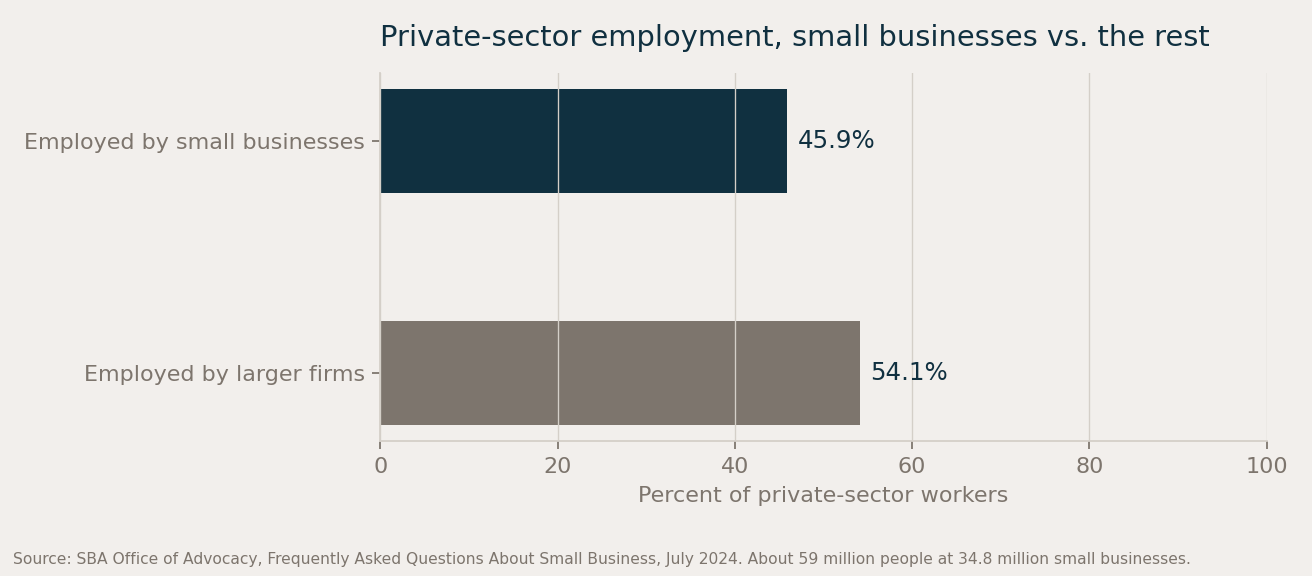
Small businesses are not a side story. The SBA Office of Advocacy counted 34.8 million of them in its July 2024 FAQ, employing 45.9% of private-sector workers, about 59 million people. When the owner dies unprepared, the damage is not abstract.
Two checks, two different people
Personal life insurance pays your family. It replaces income, covers the mortgage, and can retire debts you guaranteed with your name. Key person insurance, still often called key man insurance, pays the company. The business owns the policy and is the beneficiary. The cash is there to recruit a replacement, cover a revenue dip, or fund a buy-sell so partners are not negotiating a price with a grieving spouse.
Those are different jobs. A family policy does not keep payroll current. A company policy does not pay your kids' rent.
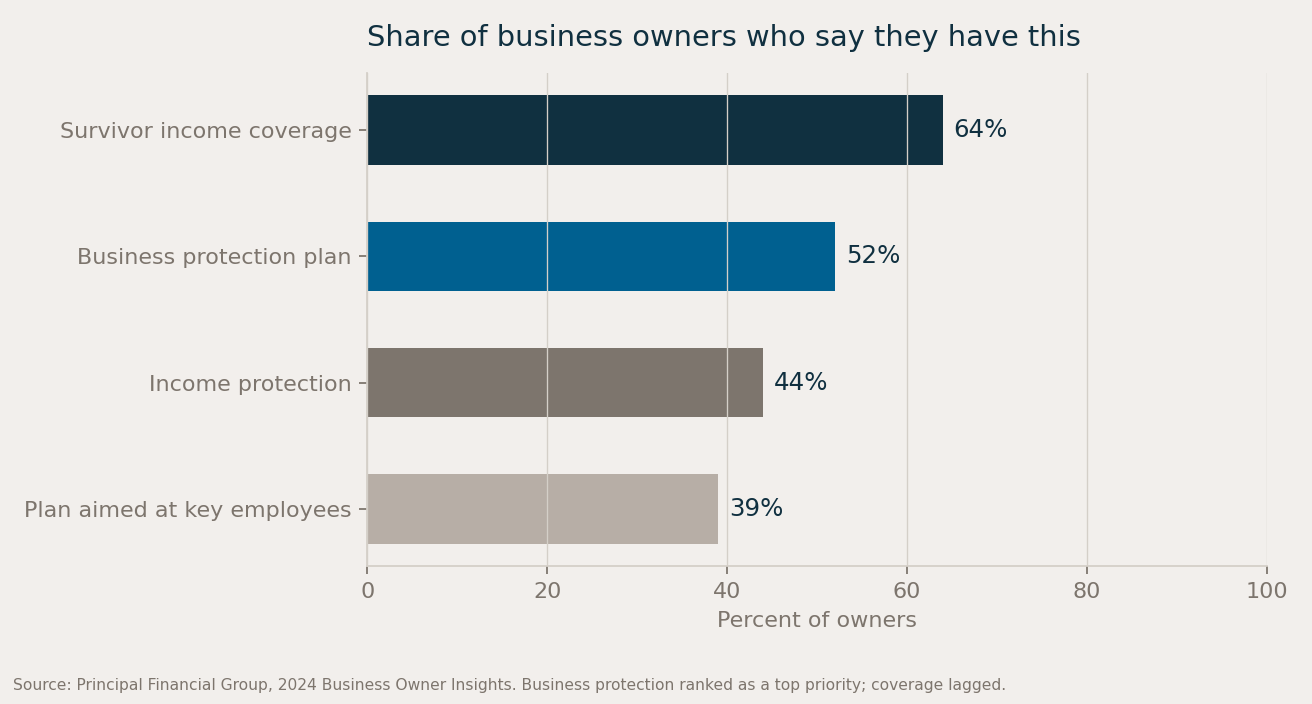
Principal's 2024 Business Owner Insights survey put business protection at the top of owners' priority list. Only 52% said they had a plan. Income protection sat at 44%. A plan aimed at key employees sat at 39%. Survivor income was better, at 64%, which still leaves about a third of owners without individual life insurance for the household.
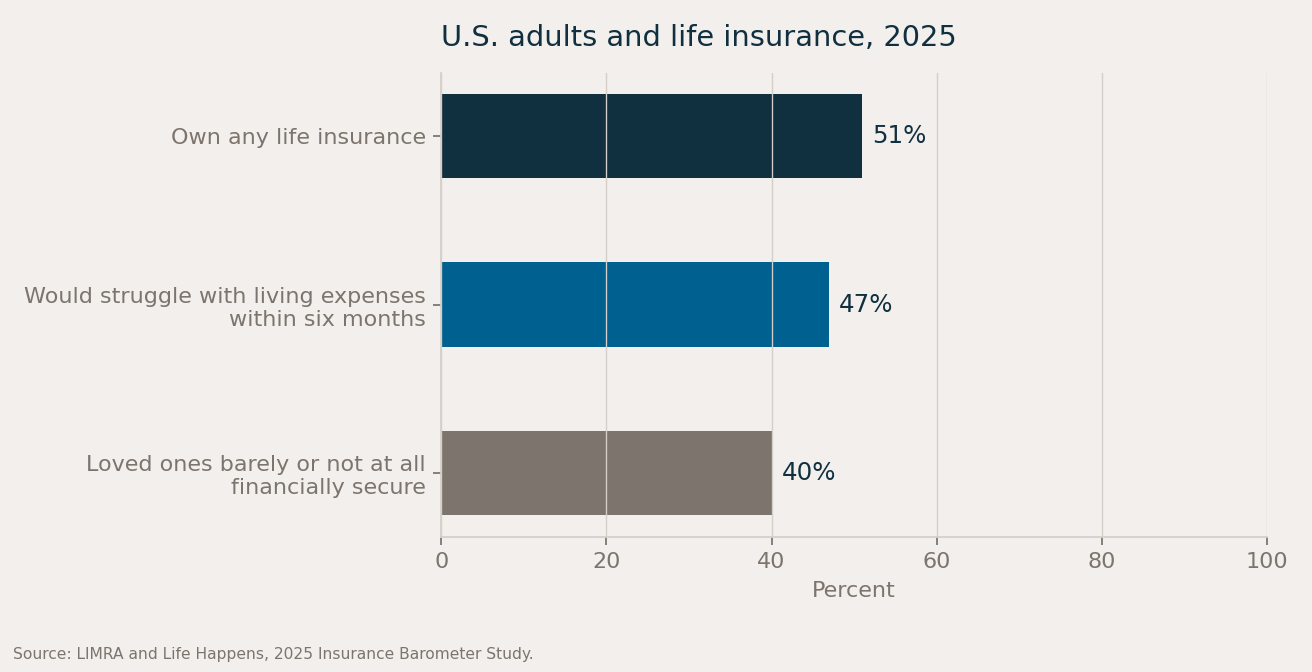
The household picture is no kinder. LIMRA and Life Happens, in the 2025 Insurance Barometer Study, found that 51% of U.S. adults own any life insurance. Nearly half, 47%, said they would struggle with living expenses within six months if the primary wage earner died. Forty percent said their loved ones would be barely or not at all financially secure.
What no policy actually looks like
Public write-ups rarely say "he had no life insurance" in so many words. Two cases show the bill landing on other people. In one, the missing policy is explicit.
A three-person company, and a buy-sell with no cash. In 2012, Canadian estate lawyer Lynne Butler published a letter from a surviving partner. One of three owners had died and left his shares to his children. The company had made only a couple of thousand dollars and carried more than $70,000 in debt. The shareholders' agreement still required the survivors, or the company, to buy those shares back. Butler's point was blunt: there was apparently no life insurance in place, even though insuring each owner is the usual way to fund that kind of buy-back. The children were handed shares in a weak company. The estate had nothing to contribute. The surviving partners were contractually stuck buying something they described as nearly worthless, while everyone argued about debts the estate did not even owe. Employees and customers were attached to a firm whose owners were now in a legal knot instead of selling the next job.
Randy Hansen, AgVenture Feed and Seed. Hansen died in January 2003 at 34, three months after a leukemia diagnosis, according to an Associated Press account published by Insurance Journal in 2019. His wife, Sandy Hansen-Wolff, found the Watkins, Minnesota feed business close to bankruptcy. He had just bought out a partner. A later case study by Apex Business Advisors put annual revenue around $1 million and described a $500,000 loan secured against her home, plus a seven-year payout. There were no written procedures. Employees did not know the margins. Suppliers said, where she could hear it secondhand, that she would never keep the place open. Customers in a male-dominated farm trade had to decide whether to keep ordering from a 30-year-old widow who had not run the company. She did keep it open, grew it, and years later sold it. That is a survival story, not a plan. The public record does not describe a life insurance check that cleared the house or funded a manager. What it does describe is a widow personally on the hook, a staff with no playbook, and a business that could not have been sold in the shape she inherited.
What to put in place this quarter
You do not need a perfect estate plan to stop the worst version of this.
- A personal policy sized to income, the mortgage, and any debt you signed for.
- A key person policy owned by the company, on you and on anyone whose relationships or skills would take a year to replace.
- A written buy-sell that says who may buy, at what price, and that the insurance is the funding. An unfunded agreement is a promise with no cash, which is what trapped those three partners.
- A one-page operating sheet: payroll logins, the bank contact, license renewals, and who can sign checks on Monday.
Key person coverage is not a substitute for a will, and a will is not cash. PRP, a Watertown, Massachusetts research firm, nearly died with founder Francis Chao in 1994 because investors would not fund a company with no successor. Inc. reported that a $2.5 million key person policy was, in a senior executive's words, the only reason it survived. That is the version with the policy. The version without it is a closed sign, a house on the line, or a buyout nobody can pay.
If you are the business, buy the coverage that pays the business. Then buy the one that pays the people who will still be here if you are not.
Ensemble Advisor is a publisher of general consumer education on personal finance, taxes, retirement, and estate planning. It is not a registered investment adviser, CPA firm, or law firm, and it is not affiliated with Ensemble Financial Strategies (ensembleadvice.com). Nothing here is personalized advice. Referrals to professionals may be compensated.
Sources
- Office of Advocacy, U.S. Small Business Administration. "Frequently Asked Questions About Small Business, July 2024." December 2024.
- Principal Financial Group. "2024 Principal Business Owner Insights." April 11, 2024.
- LIMRA and Life Happens. "2025 Facts About Life Insurance," drawn from the 2025 Insurance Barometer Study. 2025.
- Lynne Butler. "Business owner dies leaving a mess that could have been prevented." Estate Law Canada, November 22, 2012.
- Joyce M. Rosenberg, Associated Press. "Uncertainty Follows Grief When Small Business Owners Die Without Succession Plans." Insurance Journal, June 28, 2019.
- Apex Business Advisors. "Case Study #61: Turning Tragedy Into Triumph." April 11, 2022.
- Jill Andresky Fraser. "Insurance: Hindsight Advice on Key-Man Coverage." Inc., March 1, 1996.